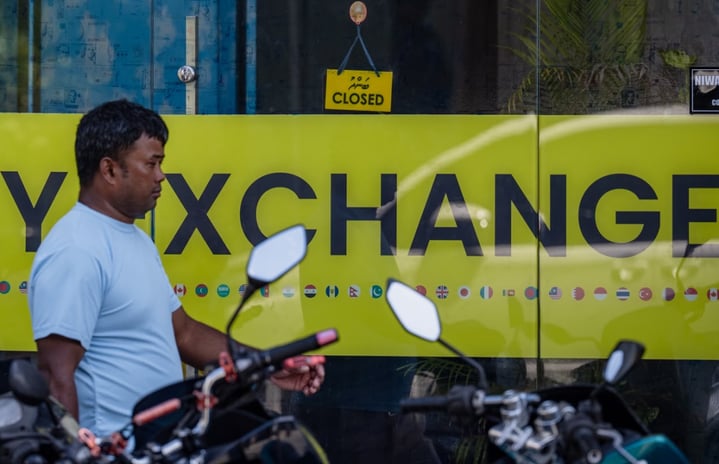
Maldives Monetary Authority (MMA) has brought new regulations governing money-changing businesses under the Foreign Currency Act into effect Wednesday.
The regulations apply exclusively to businesses providing foreign currency exchange services. Commercial banks registered and operating in the Maldives are exempt.
Under the new rules, money exchange businesses may exchange cash up to a maximum of MVR 50,000, or its equivalent in foreign currency, per customer in a single transaction or across multiple transactions within one day.
Transactions exceeding this limit must be conducted through the registered business’s primary bank account, in accordance with the regulations. Any excess foreign currency held at the end of the business day must also be deposited into the bank account on the next working day.
Under the new framework, Category A licenses for providing foreign currency exchange services to the public will only be issued to companies dedicated to this business, whose ultimate beneficial owners are Maldivian citizens.
A corporate group may hold only one licence. Tourist resorts will also be granted special permission to sell foreign currency to tourists staying at their properties.
Money changing licenses will be issued for five years. The security deposit required from each licensee has been increased to USD200,000, while an additional USD100,000 deposit must be maintained for each service outlet apart from the main business premises.
The licence application fee has been set at MVR 40,000, with a renewal fee of MVR 20,000 and an annual fee of MVR 48,000.
The regulations also introduce stricter requirements for business premises. Money changers must operate from an office with a dedicated counter to ensure customer safety and confidentiality. Exchange rates must be displayed on a digital board clearly visible to the public.
Businesses must issue official receipts for every transaction and retain transaction-related documents and records for at least five years.
They are also required to establish an electronic system for real-time transaction monitoring and submit audited annual financial statements to the MMA.
The authority has been granted powers to take strict action against businesses that breach the regulations or operate without a licence or in violation of the law.
Penalties include fines ranging from MVR 10,000 to MVR 1 million, as well as the suspension or revocation of licences. If a fine remains unpaid for 90 days, the MMA may also request the suspension of services provided by government agencies and refer the matter for criminal investigation.
Businesses already operating under licenses issued under the previous regulations will be given a transitional period to obtain licenses under the new framework and meet the revised requirements.
However, MMA has abolished the previous Tier 2 category and decided to reject applications submitted under that category, refunding the application fees paid by applicants.
Applicants who had applied under Tier 1 will be allowed to proceed with their applications under the new regulations without paying an additional fee.
The new regulations come amid increased concerns over black market dollar trading in the Maldives. MMA has recently revoked the licenses of several money changers.
The authority has also introduced a modern system to monitor and report the activities of money exchange businesses.